
For Multi-Facility Operators & Ownership
An unbudgeted liability just went live across your facilities.
HB 2336 fines, workers' comp claims, and nurse turnover are three separate budget lines that trace to one event: a resident on the floor, handled by hand. The FloorRiser Active removes that event. One staff member, under 60 seconds, no EMS call.

The liability, multiplied
HB 2336 exposure is per facility so it scales with your portfolio.
Once a municipality adopts the ordinance, it can bill for non-emergency EMS lift-assist calls above 6 per year. The average facility logs 21–32 such calls annually.
At a single site that's a line item. Across a portfolio, it's a five- or six-figure recurring liability most operators haven't priced into next year's budget.
The law is enabling. A facility carries no exposure until its municipality passes a local ordinance. Adoption is rolling, which is why equipping ahead of it avoids the cost entirely.
Count only facilities whose municipality has (or is about to) adopt the ordinance.
Non-emergency calls above the 6/year threshold are billable. Typical range 21–32.
Decatur, IL is currently $500/call. Set to your municipalities' rate.
Estimate only. Billable calls = calls above the 6/year threshold; this tool multiplies (calls above 6) × cost per call × facilities. Exposure applies only in municipalities that have adopted an HB 2336 ordinance. Equipment estimate assumes one unit per facility at $2,199; multi-floor sites may need more, and volume pricing applies. Verify local ordinance status before projecting exposure.
Three budget lines, one cause
The same event drives all three of your biggest care-side costs.
Fines, workers' compensation, and injury-driven turnover look like separate problems on separate ledgers. They share one root cause - a manual floor lift - and one fix.
Body mechanics training does not reduce injury rates. The load of lifting a person off the floor exceeds NIOSH's 35 lb safe limit regardless of technique. Which is why the only durable fix is removing the manual lift, not retraining around it.
One person. No manual lift.
What your staff actually does, in 3 steps
 1
1
Position
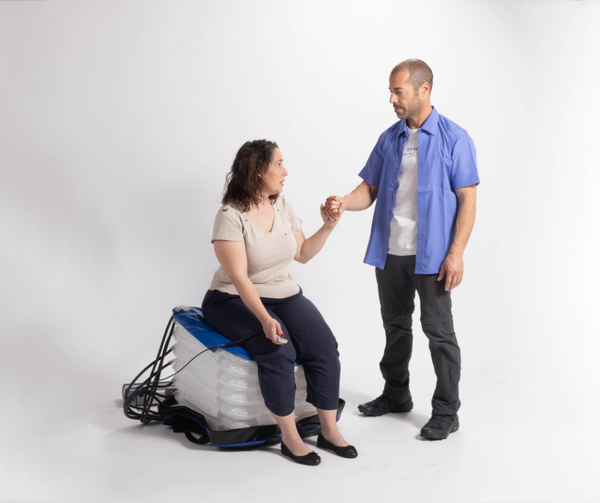
One staff member slides the FloorRiser flat under the resident, even in tight bathrooms or hallways.
 2
2
Lift & Stand
Press up. The resident rises from floor to standing at their own pace. Zero manual lifting from staff.
 3
3
Fold & Store
Deflate, fold back into the attached carry bag. Wiped down in under 2 minutes, ready for the next call.
For your operations & clinical leadership
Passing this to your team?
What operations and clinical leads need to know.
The decision usually involves your DON and operations lead. Here's the short version for them: the same device the budget case is built on, from the floor-level view.
The numbers
The cost of inaction vs. one device.
Per facility, at $2,199 with payback under 3 months and the equipment cost is fixed while the liabilities recur every year.
Fine estimates based on Decatur, IL implementation ($500/call) and CDC fall-rate benchmarks. Workers' comp and turnover from NIOSH and NSI 2025. Figures are per facility; portfolio exposure scales with facility count. Verify local ordinance status before projecting exposure.
For ownership & operations
What operators ask before a portfolio rollout.
What is our portfolio-wide exposure under HB 2336?
HB 2336 exposure is per facility, per year. Once a municipality adopts the ordinance, it can bill for non-emergency EMS lift-assist calls above 6 per calendar year, up to the actual cost of the response (e.g. $500 per call in Decatur, IL). For an operator, multiply the per-facility exposure by the number of facilities in adopting municipalities. The law is enabling. A facility has no exposure until its municipality passes a local ordinance, so exposure grows as more municipalities adopt.
How many municipalities have adopted the ordinance so far?
As of June 2026, Decatur has implemented at $500 per call and Springfield is in active review. Most other Illinois municipalities are monitoring outcomes before moving forward. Because adoption is rolling, operators that equip ahead of adoption avoid the fines entirely rather than reacting after they begin. Verify the status for each of your facilities' municipalities directly with the local fire department or city clerk.
How does FloorRiser Active reduce fine exposure across facilities?
HB 2336 fines apply specifically to calls where EMS is dispatched for a non-emergency lift-assist. FloorRiser Active enables one staff member to handle a floor-to-stand assist without calling EMS — eliminating the billable call. Deployed across a portfolio, it reduces the volume of billable calls at each facility. Actual reduction depends on each facility's ratio of emergency vs. non-emergency incidents.
How does this affect our workers' compensation risk profile?
Manual lift injuries are among the highest-frequency workers' compensation claims in skilled nursing. Each back-injury claim averages $15,000 – $20,000, with indirect costs typically running three to five times that. Claim frequency shapes an operator's experience modifier and premiums over time. Removing the manual floor lift removes the event that generates these claims. Some carriers offer equipment incentives for documented injury-prevention tools. Confirm with your carrier.
What is the impact on nurse turnover and staffing cost?
The 2025 NSI National Health Care Retention & RN Staffing Report puts the average cost of replacing one RN at $61,110. Manual lifting is responsible for 60% of nurse back injuries, and injured staff leave at higher rates. Across a portfolio, even a modest reduction in injury-driven turnover represents a material annual saving relative to the cost of the equipment.
How does manual lifting injury risk work? Isn't training enough?
Research consistently shows body mechanics training does not reduce manual lift injury rates. The biomechanical stress of lifting a person off the floor exceeds safe limits regardless of technique. NIOSH sets 35 lbs as the maximum safe single-person lift. Most residents weigh significantly more. Only removing the lift itself removes the injury risk.
What does a multi-facility rollout look like?
Most facilities start with 1–2 units; facilities with multiple floors or high call volumes typically place one unit per floor or wing. Volume pricing is available for multi-unit and multi-facility orders. Staff are typically confident using the device within days. It has two controls, up and down, and requires no formal certification. Contact us to scope a rollout across your portfolio.
How does it perform on night shift with limited staff?
Night shift is where FloorRiser Active has the most impact. Most falls occur at night, when staffing is thinnest. The device lets a single nurse handle a floor-to-stand assist safely. Without calling for backup, waking a second aide, or waiting for EMS. One person, under 60 seconds.
Is FloorRiser Active consistent with CMS safe patient handling guidance?
Yes. FloorRiser Active eliminates manual floor lifting, which directly addresses NIOSH safe patient handling guidelines (maximum 35 lb single-person lift). Using a mechanical lift device for floor-to-stand transfers is consistent with CMS safe patient handling guidance and reduces the documentation risk associated with unassisted manual lifts on survey review.
What is the weight capacity?
600 lbs (272 kg), making it suitable for bariatric residents who typically require two-person manual assists. This is among the highest weight capacities available in portable floor-lift devices.
How is it different from a Hoyer lift or ceiling lift?
Ceiling lifts and Hoyer lifts require installation, room-specific hardware, and typically a two-person operation. FloorRiser Active requires no installation, no dedicated space, and no second person. It weighs 17 lbs, moves between rooms in a carry bag, and is designed specifically for floor-to-standing transfers. The scenario that generates the most EMS calls and the most staff injuries.
Do you offer bulk or multi-facility pricing?
Yes. Volume pricing is available for multi-unit and multi-facility orders. Contact us directly for a portfolio quote. Email or phone, both listed below.
Is an evaluation unit available before we commit?
Yes. We can place an evaluation unit in one of your facilities so your operations and clinical teams can assess FloorRiser Active on a real floor, with real residents, before any portfolio decision. It ships with a 60-day satisfaction guarantee. Reply to any email from our team or call us to arrange.
What is the payback period?
At $2,199 per unit and current HB 2336 fine rates ($500/call in Decatur), a facility with 7 or more billable EMS calls per year recovers the device cost in under 3 months. If a single lift-related workers' comp claim is prevented, the device pays for itself approximately 14–23 times over. If a single nurse replacement is avoided, it pays for itself approximately 28 times over.
How is FloorRiser Active categorized for budget purposes?
FloorRiser Active qualifies as durable medical equipment and is typically expensed as a capital or operational equipment purchase. Consult your finance team for the appropriate categorization under your accounting policies.
Put one on a floor
before you commit the portfolio.
We'll place an evaluation unit in one of your facilities so your operations and clinical teams can assess it on a real floor — risk-free, with a 60-day satisfaction guarantee. If it earns its place, we scope the rollout. If it doesn't, send it back.